
Why Projects Don’t Finish on Time
The Moving Targets, Hidden Workloads, and Decision Bottlenecks That Derail ERP Implementations
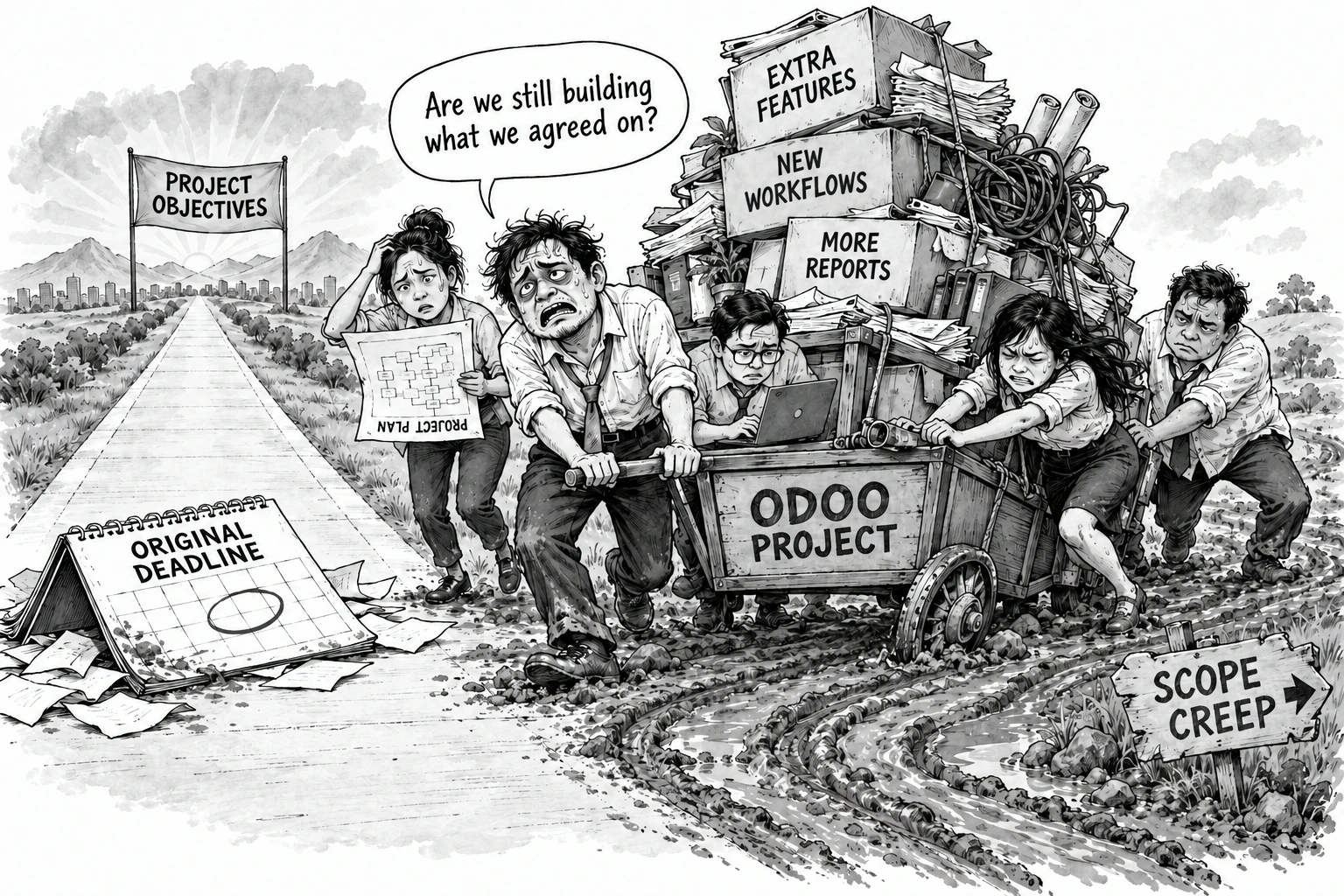
The Odoo demonstration went well. Management saw the possibilities, approved the proposal, and agreed on a launch date.
“Could this also handle our other branch?”
“We have reorganized the department. Can we change the workflow?”
Meanwhile, finance has not submitted its opening balances. Sales has not validated its customer records. The project coordinator is waiting for management to approve a process change.
The launch date moves. Frustration grows. Someone asks: Why is the implementation taking so long?”
Technical difficulties and weak implementation practices can certainly cause delays. But business owners should also examine the organization surrounding the project: how it defines requirements, allocates people, and makes decisions.
An Odoo implementation connects information, workflows, and responsibilities across departments. Its schedule depends on those connections working.
Three documented ERP cases—two Odoo implementations and one cautionary example from another platform—help illustrate why.
1. Scope Creep: When Every Possibility Becomes a Requirement
Odoo’s breadth can turn an implementation workshop into a wish-list session.
“Simplicity—the art of maximizing the amount of work not done—is essential.”
- Principles behind the Agile Manifesto. 1
Case 1: G&L Systemhaus—Launch the Core, Then Improve
The G&L team also reported:
“By automating and consolidating several applications in Odoo, we have achieved time savings of approximately 40% in invoicing.” 2
The management lesson: A first release can create measurable value without containing every desirable capability.
How to protect your Odoo scope
Maintain a separate backlog for improvements. For every addition, ask:
- What business problem does it solve?
- Must it be available at the first launch?
- What other work will it affect?
- What changes in budget, workload, or delivery date?
An approved addition must come with an approved consequence.
2. Scope Collapse: When the Original Plan Stops Matching the Business
Dwight D. Eisenhower captured the importance of continuing preparation when he repeated an Army saying:
“Plans are worthless, but planning is everything.” 3
Applied to implementation, the value lies in understanding assumptions and dependencies well enough to revise the plan intelligently.
Case 2: XLG—A Defined Rollout Within a Complex Group
The case does not document “scope collapse.” Its relevance is the challenge of establishing common processes across varied operations—a challenge organizational changes can intensify.
How to keep the scope grounded
Change the parts whose assumptions have changed. Preserve the parts that remain valid.
3. The Invisible Workload: When Implementation Becomes Everyone’s Second Job
Employees must explain processes, clean records, investigate inconsistencies, test transactions, and provide feedback. Their regular responsibilities continue.
Finance still has closing deadlines. Warehouse staff still have deliveries. Sales still has targets.
Project work loses to urgent operational demands.
The resulting delay spreads through dependencies: configuration waits for information, testing waits for configuration, and training waits for stable workflows.
How to make internal capacity visible
Every major deliverable needs an owner, an effort estimate, a deadline, and clear quality requirements. “Submit inventory data” is insufficient. Specify fields, formats, validation rules, and the person authorized to approve corrections.
Provide templates early and validate a small sample before employees prepare the full dataset.
Most importantly, management must decide which regular duties will be reassigned, postponed, or supported.
Assigning project responsibilities without releasing time creates a schedule built on hope.
4. Responsibility Without Authority: When the Lead Can Only Follow Up
The project lead is expected to obtain information from department heads, reconcile requirements, and secure executive approvals. Yet that person cannot set departmental priorities or resolve disagreements.
Being a subordinate does not prevent someone from leading successfully. The problem is a mandate that carries responsibility without sufficient decision rights or executive backing.
Case 3: U.S. Navy ERP—Risks Identified, Authority Missing
A 2008 U.S. Government Accountability Office audit found that the Navy ERP program was more than two years behind schedule. Among the weaknesses were ineffective mitigation of data conversion and organizational change risks.
The report stated that, according to program officials, the program office:
“does not have the authority to compel the user organizations to execute their part of the mitigation strategy.”
The management lesson: Identifying a dependency is insufficient when nobody can ensure the responsible department delivers it.
How to give the project effective authority
Authorize the operational lead to make routine decisions within agreed limits. Name process owners who can approve workflows and validate results.
Set response deadlines and an escalation route. A routine decision might have a three-working-day target, for example, with overdue items referred to the sponsor.
Record decisions, owners, and consequences. Repeatedly discussing an unresolved issue should trigger escalation.
Why These Problems Reinforce One Another
Each explanation calls for a different remedy.
What Senior Managers Should Review Every Week
A useful project review should produce decisions and remove obstacles.
Review area | Question management should ask |
Scope | What changed, and have we approved its consequences? |
Capacity | Do employees have time to deliver their commitments? |
Dependencies | Which unresolved item is holding up critical work? |
Authority | Who must decide, and by when? |
Readiness | Can users complete realistic transactions with validated data? |
Schedule | What evidence supports the current launch date? |
Require the implementation partner to provide equally transparent reporting on its own deliverables, defects, estimates, and staffing. Accountability belongs on both sides.
Finishing Begins With Leadership
The answers may reveal the most effective place to intervene.
XEM, Xcitech Business Consulting
[2]: https://www.odoo.com/blog/customer-reviews-6/gl-systemhaus-2040?utm_source=chatgpt.com "Odoo Success Story: How G&L Boosted Efficiency by 40%"
[3]: https://www.eisenhowerlibrary.gov/eisenhowers/quotes?utm_source=chatgpt.com "Quotes"
[4]: https://www.odoo.com/ar/blog/customer-reviews-6/transforming-a-9-000-employee-company-in-just-six-months-1342?utm_source=chatgpt.com "XLG: Transforming a 9,000-employee company in 6 months"
[5]: https://www.gao.gov/assets/a280055.html?utm_source=chatgpt.com "GAO-08-896, DOD Business Systems Modernization: Important Management Controls Being Implemented on Major Navy Program, but Improvements Needed in Key Areas"